Author: Mausumi Dikpati
Apr 28, 2023
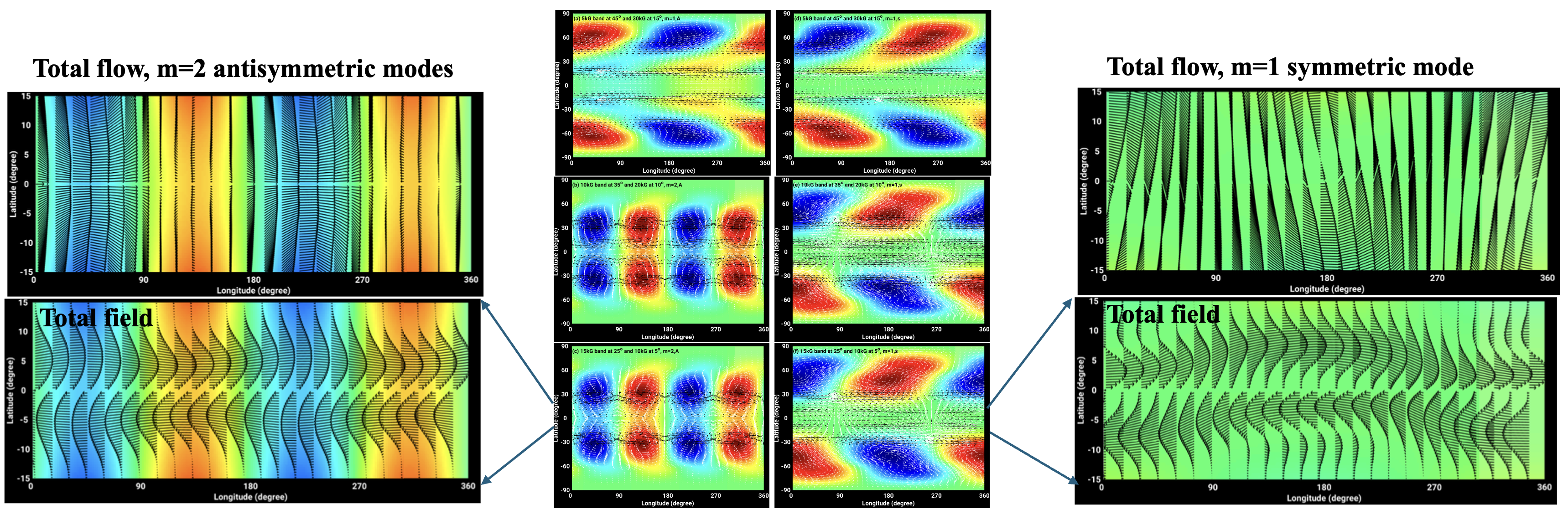
Motivated by observations of extended solar cycle, Belucz et al. (2023) considered a double-band system consisting of two oppositely-directed toroidal bands in each hemisphere, and studied their global instability in a quasi-3D MHD shallow-water tachocline model. As the two oppositely-directed bands in each hemisphere move equatorward, it is found that the high- and low-latitude bands interact in the same hemisphere when they are respectively at latitudes 60 and 30 degrees. The interaction between the bands in the same hemisphere continues as they migrate equatorward until the high- and low-latitude bands arrive respectively at latitude around 45 and 15 degrees, when a cross-hemispheric interaction between the two low-latitude bands starts.
Here, band-interaction occurs by teleconnection mechanism, physics for which has long been known in meteorology in the context of sea-level pressure and height fields (Lorenz, 1951) and atmospheric circulation (Blackmon et al., 1984). This concept is relatively new for the Sun. Teleconnection is essentially a contemporaneous correlation among various global fluid properties and parameters at remotely separated regions and their influence on each other. This was demonstrated in a pioneering paper by (Wallace & Gutzler, 1981) to be created by planetary waves in the North Atlantic and North Pacific Oscillations, which are characterized by north-south seesaws in the sea-level pressure fields. The teleconnection physics relies on the tilts of Rossby wave patterns, which can help connect the stream functions and/or magnetic patterns (in the solar context) of two remote regions, which can be located in the same hemisphere or in two different hemispheres, but requiring a certain minimal separation. If the tachocline toroidal bands represent at least a good part of the possible sources of active regions manifested at the surface, then the low-latitude bands reaching 15-degrees in each hemisphere is the time when the solar cycle enters the waning phase.
Belucz, B., Dikpati, M., McIntosh, S.W., Leamon, R.J., & Erdélyi, R. 'Magnetohydrodynamic Instabilities of Double Magnetic Bands in a Shallow-water Tachocline Model. I. Cross-equatorial Interactions of Bands'. ApJ, 945, 1 (2023). DOI:10.3847/1538-4357/acb43b