Author: John ('JT') Stefan
Feb 1, 2023

- Espresso Ristretto /ri’stred ̄o /
- noun: a drink of very strong, concentrated espresso.
- noun: a COFFIES Espresso Shot that highlights research from a dissertation.
While two and a half decades of observations by SOHO and SDO have yielded key insights into the structure and dynamics of active regions, there remain many open questions on how helioseismic methods can be extended to learn more about active regions properties. In particular, can active regions be identified before emerging on the solar surface and, once emerged, can the subsurface structure of an active region’s magnetic field be measured. Regarding the dynamical processes associated with active regions, it is still unclear how and where sunquakes are excited. To answer these questions, we complete a comprehensive survey of active region magnetic fields and their associated helioseismic signatures. We directly study the magnetic fields associated with active regions for both the pre-emergence and post-emergence phases. For the former, we use deviations of the mean phase travel time of acoustic waves to detect the rise of magnetic flux from the solar interior. These deviations are associated with perturbations to the wave speed; in particular, we detect deviations associated with an increase to the wave speed, caused by the contribution of magnetic pressure. We first reproduce the results of Ilonidis et al. (2013), where mean phase travel time deviations are detected prior to the emergence of several active regions, and provide some calibration and testing of the technique outlined in their work with simulations of submerged sound speed perturbations developed by Hartlep et al. (2012) and Stejko et al. (2020). We then apply the technique to a collection of 46 active regions to determine the statistical significance of mean travel time perturbations as a signature of pre-emerging active regions. We find that a majority of the studied active regions (up to 34 of the 46 active regions) have mean phase travel time deviations that are most well-correlated with the surface magnetic flux prior to emergence.
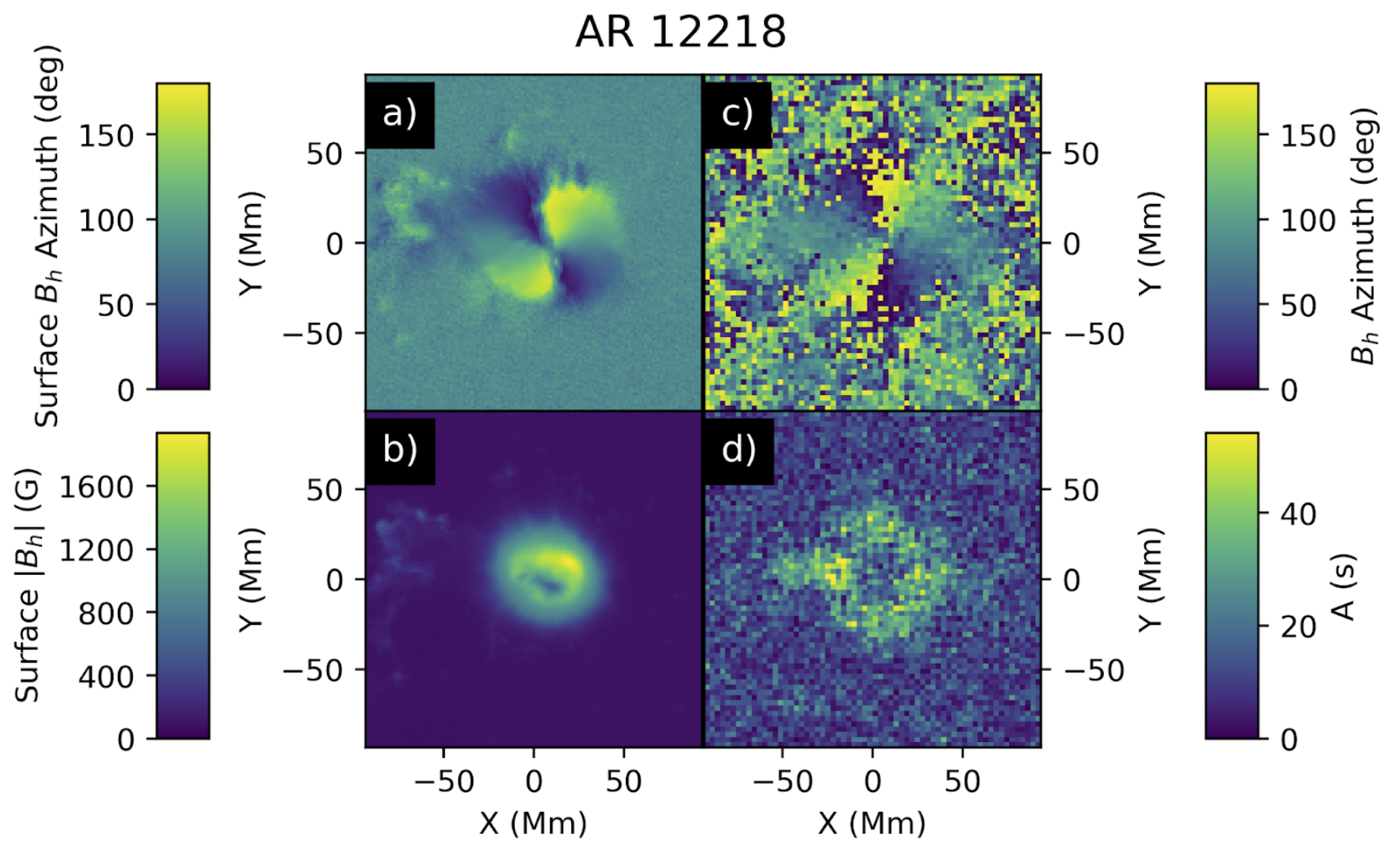
Additionally, we develop a novel technique for the study of existing active region magnetic fields. By combining the travel time of acoustic waves traveling in varying directions, we are able to isolate perturbations due to subsurface horizontal magnetic fields from those caused by structural changes, such as those to sound speed and cut-off frequency. The resulting measurements are used to provide a proxy for the magnitude of the horizontal magnetic field as well as a direct measure of the field’s azimuth. We apply the technique to the sunspot simulation developed by Rempel (2012) for validation, and the results are compared with the true subsurface state of the sunspot as well as the theoretical measurements derived from ray tracing. The measurement scheme is then used to investigate the subsurface magnetic structure of several sunspots. We find the azimuth measurement to be quite accurate (±3 degrees) in the realistic sunspot simulation, though measurements near the central portion of the sunspot (∼ 10 Mm) are significantly distorted, likely from the failure of the assumption of a uniform magnetic field used in the derivation of the technique. These distortions were not seen after applying the method to several active regions observed by HMI (Figure 1 below), though the spatial resolution here is significantly coarser. Additionally, we found evidence for subsurface connections in sunspots which have a nearby flux patch, as in Figure 1c and 1d, where the orientation of the magnetic field is aligned in the East-West direction between the sunspot and flux patch and the travel time anisotropy enhanced in this region as well.
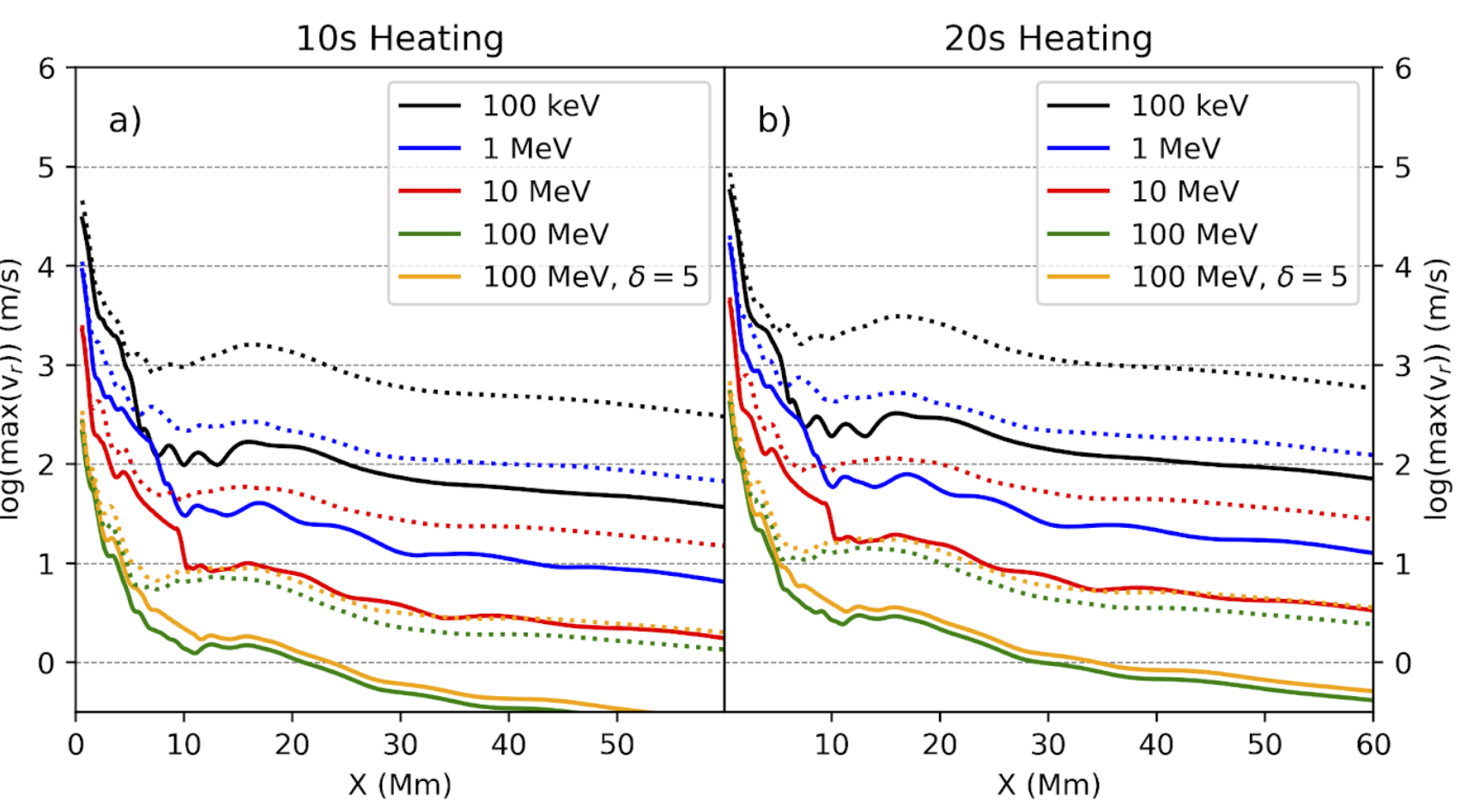
Finally, we construct a model of solar acoustic wave propagation using the compressible form of the mass, momentum, and entropy conservation equations for studying sunquakes. The constructed model is used to determine at what height sunquakes are excited, what mode of excitation is most energetically favorable, and what properties of particle beams are relevant to sunquake excitation. To determine the excitation height, we create a catalog of simulated sunquakes for a range of central locations from 200 km below to 450 km above the photosphere and for several excitation mechanisms. By comparing the waveforms and surface amplitudes of the simulated and observed sunquakes, we provide estimates for the excitation height and the associated energy needed to reproduce the observations. Additionally, we use the output of FP (Allred et al. 2022) proton beam simulations to derive forcing functions for the excitation of sunquakes in our model, and compare the resulting wave packet amplitude to observations. In our comparison of the simulation catalog with observed events, we were unable to find a common excitation height. However, the simulations showed a consistent trend of increasing excitation as the source location deepens, and a similar trend for increasing wave damping. The FP-derived heating functions are computed for several low-energy cutoffs of the proton energy distribution ranging from 100 keV to 100 MeV. We find that while the smallest low-energy cutoff beam does not penetrate very deeply into the solar atmosphere, it generates the strongest amplitude sunquake (Figure 2 below) from the large acceleration of the relatively thin plasma. The proton beam with the 100 MeV cutoff penetrated very deeply into the solar atmosphere yet excited a comparatively weak sunquake; a significant proportion of the excitation energy is deposited into gravity waves as opposed to the pressure waves which compose the sunquake wavefront. For this reason, we do not expect proton beams with such large high-energy cutoffs to be a good candidate for the excitation mechanism of sunquakes.
Stefan, J.T. (2022), "Helioseismic Diagnostics of Active Regions and Their Magnetic Fields.", Ph.D. Dissertation, New Jersey Institute of Technology, ProQuest ID:2769573927. Digital Commons:1640.[LINK]
Congrats JT!