Author: Loren Matilsky
Feb 1, 2023
As COFFIES members no doubt know by now, a major outstanding problem in solar physics is the dynamical confinement of the solar tachocline. The tachocline, as a thin shear layer that separates nearly solid-body rotation in the radiative interior from strong differential rotation in the convection zone, is subject to diffusive spreading. Specifically, it should spread “thermally” (via radiative diffusion) unless acted upon by an—as of now, unknown—additional torque. The theoretical source of this torque falls largely into two camps, or “confinement scenarios”: Either the torque is caused by mostly hydrodynamic shear instabilities (the “fast HD scenario”), or it is magnetic, i.e., a Lorentz torque caused by a primordial magnetic field (the “slow MHD scenario”) or the cycling dynamo magnetic field (“fast MHD scenario”). Here, we present the first 3D, global solar dynamo simulations of a coupled convection-zone-stable-layer system that clearly achieves a magnetically confined tachocline. The primarily nonaxisymmetric magnetism appears to be initially built in the convection zone/overshoot layer, and then diffusively imprints downward. As a whole, this model is similar to the proposed fast magnetic confinement scenario. However, the field is also locally amplified throughout the radiative interior by vigorous horizontal motions that in our simulation, seem to arise from a combination of equatorial Rossby waves and possibly multiple types of instability. Our work thus supports prior studies that proposed dynamo action in the radiative interior, and suggests that strong horizontal motions (which are seen in many convection-zone-stable-layer simulations using multiple codes) may be a key ingredient in such a deep dynamo.
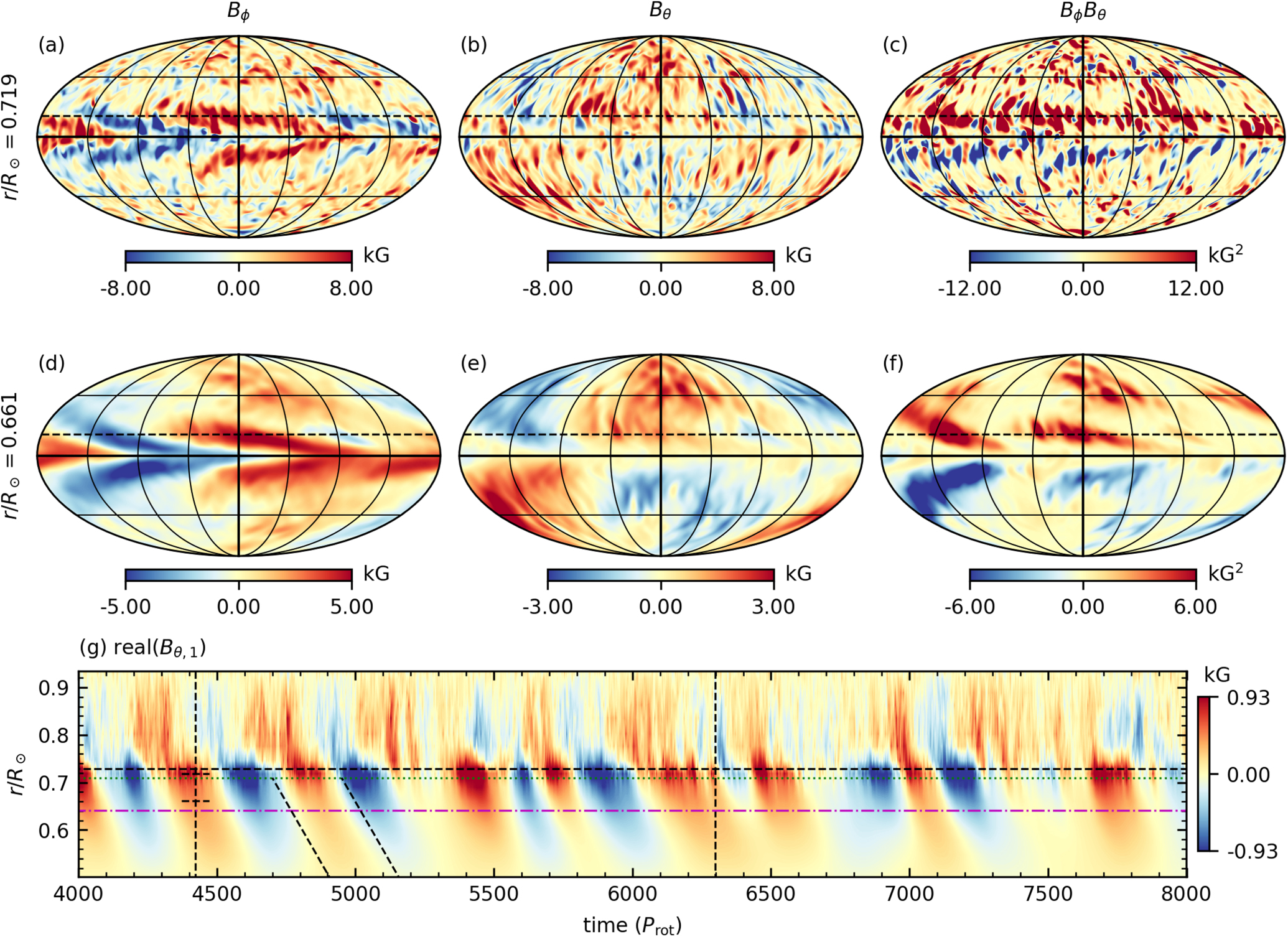
Figure 2 from the paper (below) shows a nonaxisymmetric, cycling dynamo. Snapshots of the horizontal magnetic fields (Bφ, Bθ, and their product, BφBθ) are shown at t = 4420Prot for (a)–(c) the overshoot layer and (d)–(f) the tachocline. Each field is plotted in full Mollweide view, the latitude and longitude are marked every 45° by solid curves, and 15° latitude is marked by a dashed line. (g) Real part of the m = 1 component of Bθ (i.e., real(Bθ, 1), where Bθ, 1 ≡ ⟨(Bθ)exp(-iφ)⟩) plotted as a function of time and radius at 15° latitude. The vertical dashed lines denote the time interval considered in Section 4 and Figure 3 of the referenced paper. The two ticks on the leftmost vertical line show the depths sampled by the Mollweides. The diagonal dashed lines show the speed at which diffusion would imprint the oscillating field downward from the base of the overshoot layer according to the skin effect. The skin depth is ~0.08R⊙, on par with the distance strong Bθ, 1 extends below the overshoot layer.
Video: YouTube interview (AAS channel) where Loren gives a ~45 minute description walking through the paper: https://www.youtube.com/watch?v=xmi_NNJGdPQ.
Matilsky, L.I., Hindman, B.W., Featherstone, N.A., Blume, C.C., & Toomre, J. 'Confinement of the Solar Tachocline by Dynamo Action in the Radiative Interior'. ApJL, 940, L50 (2022). DOI:10.3847/2041-8213/ac93ef