Author: Andrey Stejko
Oct 31, 2022
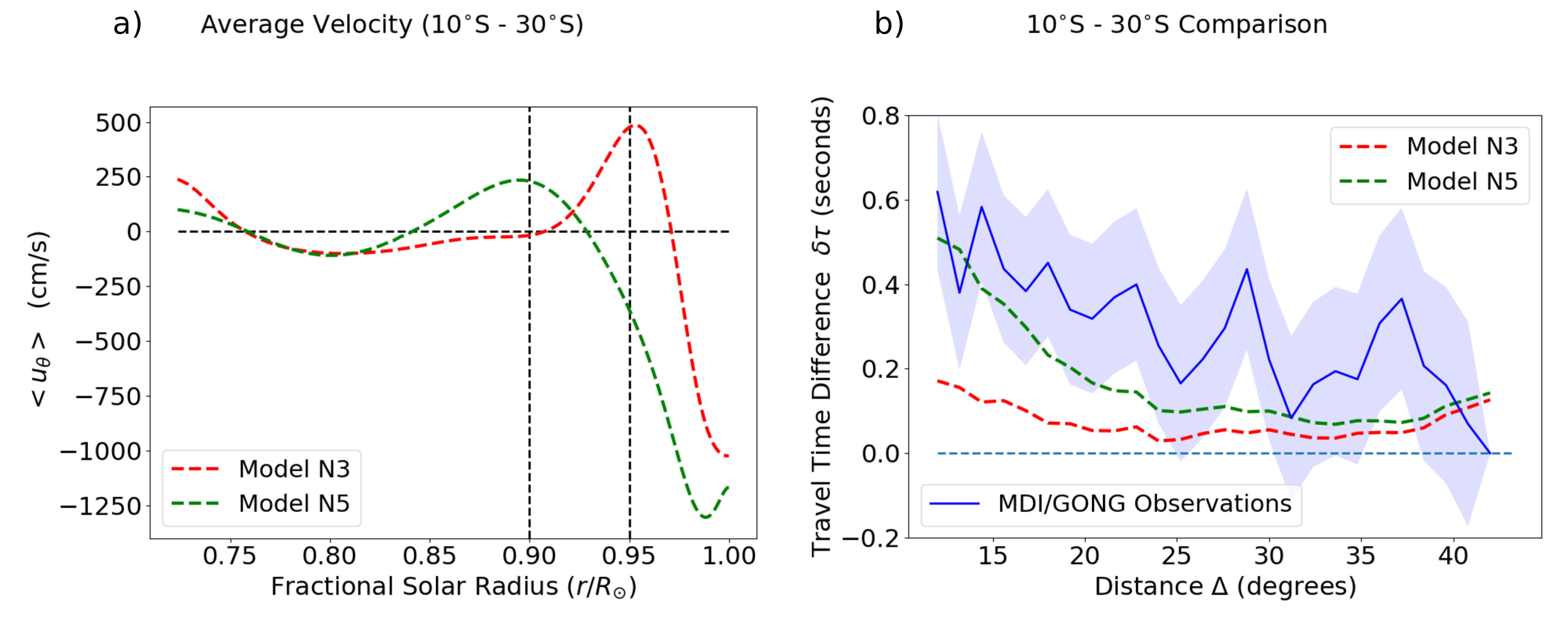
In order to develop a more robust understanding of global flow regimes in the solar interior, we apply a “forward-modeling” approach to the analysis of helioseismic signatures of meridional circulation profiles obtained from numerical simulations. We employ the global acoustic modeling code GALE to simulate the propagation of acoustic waves through regimes of mean mass-flows generated by global hydrodynamic and magnetohydrodynamic models: EULAG, the Pencil Code, and the Rayleigh code. These models are used to create synthetic dopplergram data products, used as inputs for local time-distance helioseismology techniques. Helioseismic travel-time signatures from solutions obtained through global numerical simulations are then compared directly with inferences from solar observations, in order to set additional constraints on internal velocities in a direct way. This method allows us to better characterize the impact that known solutions have on helioseismic techniques directly, without the need to rely on subsequent inversions.
The analysis of two Rayleigh models in particular (N3 and N5; Matilsky et al. 2019) demonstrate the impact of a larger, more coherent, primary circulation cell on the model surface–generated as the result of a weaker near-surface rotational constraint. We compare the average velocities in the 10°S-30°S latitudinal range for models N3 and N5 in panel (a) of the Figure, alongside the resulting helioseismic travel-times (dashed lines) in panel (b) and their observational counterpart as computed by Gizon et al. (2020) (solid line). The travel-time differences calculated for Model N5 are a better match for the observational signal at depths r > 0.80R⊙ — exhibiting an average z-score of zN5 = 0.803, as opposed to zN3 = 1.598 for Model N3. This represents an increased likelihood that the average depth of the maximum return flow in this latitude range is approximately at or slightly below r ~ 0.90R⊙, assuming an accurate scaling of surface flows (10 m/s average with a 20 m/s maximum, see Roudier et al. 2018). This methodology is currently being applied to help set constraints on solar observations as well as to analyze the impact of known solutions on the idiosyncrasies of various helioseismic techniques.
Stejko, A. M., Kosovichev, A. G., Featherstone, N. A., et al. 'Constraining Global Solar Models through Helioseismic Analysis'. ApJ, 934, 161 (2022). DOI:10.3847/1538-4357/ac7a44