Author: M. Cristina Rabello Soares
Oct 31, 2022
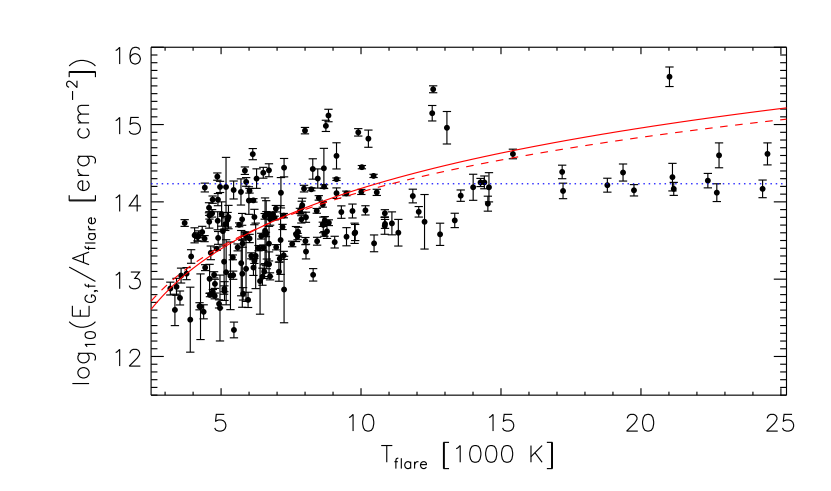
Based on these stellar temperature estimations, the white-light flare (WLF) spectrum is often described as a blackbody with a temperature between 9,000-10,000 K and used to estimate the bolometric energy of the flare (e.g., Maehara 2012, 2021, Shibayama et al. 2013). A change in the assumed flare temperature may significantly affect the energy-frequency distribution estimate, which is used to model the atmospheric conditions of the planets orbiting the flaring star that allows to assess the possibility of life and the probability of becoming a candidate for a biosignature survey (e.g., Günther et al. 2020). For solar WLFs, there is an earlier estimation of a temperature similar to that of the M dwarf stellar flares, equal to ~9000 K by Kretzschmar (2011). Later, Kerr & Fletcher (2014), Kleint et al. (2016) and Namekata et al. (2017) estimated temperatures between 5,000 and 7,000 K. Rabello Soares et al. (2022) estimated blackbody temperature, energy and area for 209 flares observed at 69 F-K stars, significantly increasing the number of flare temperature determinations, using CoRoT satellite data. The expected value of the analyzed flares is equal to 6,400 K with a standard deviation of 2,800 K, in agreement with the latest results for the Sun using HMI data.
Rabello Soares, M. C., de Freitas, M. C., & Ferreira, B. P. L. 'Blackbody Temperature of 200+ Stellar Flares Observed with the CoRoT Satellite'. AJ, 164, 223 (2022). DOI:10.3847/1538-3881/ac90cb