Author: Aimee Norton
Oct 31, 2022
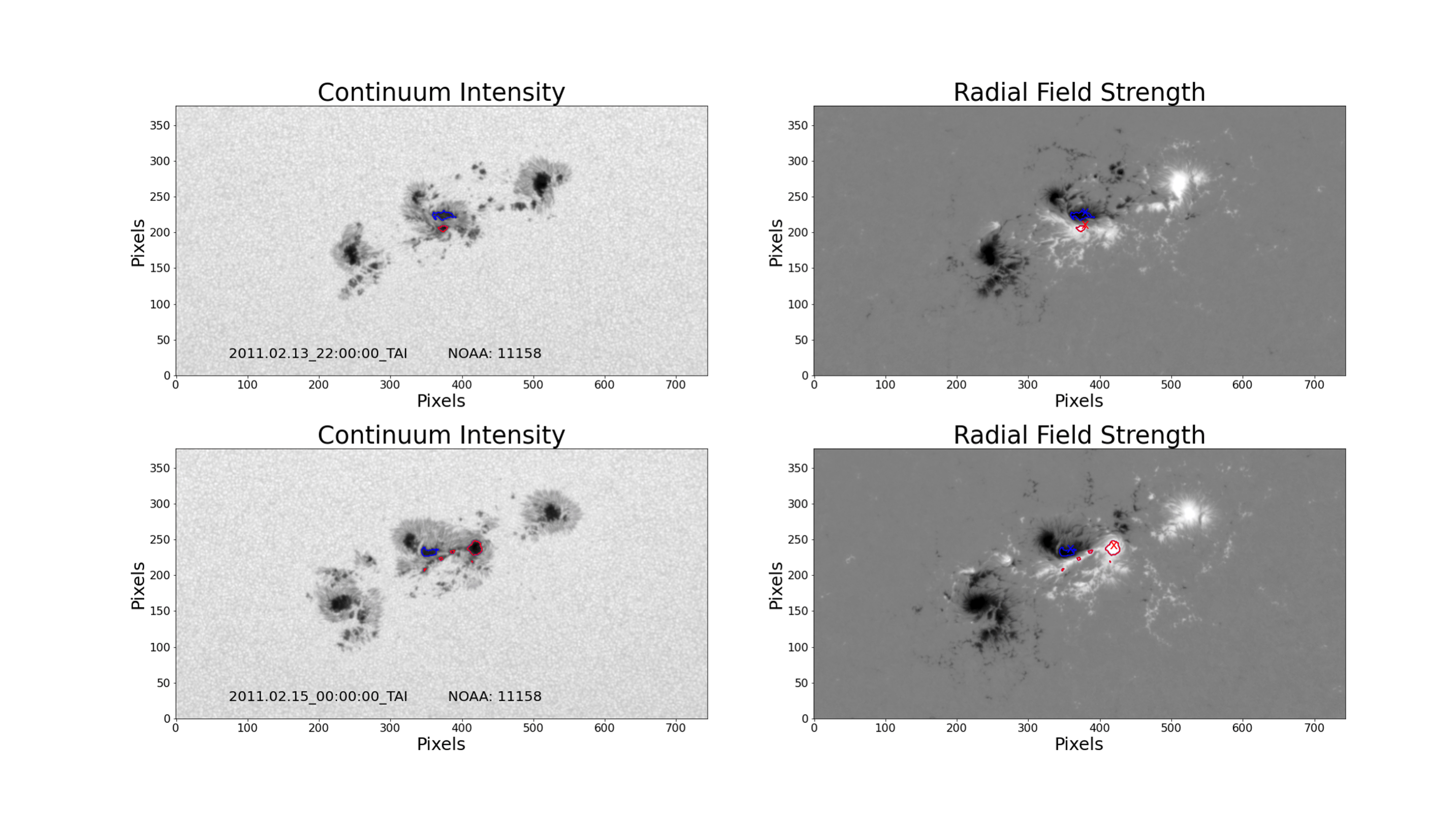
Active regions in which positive and negative magnetic polarity umbrae share a penumbra are known as δ-spots. They are disproportionately responsible for the most energetic flares in any given solar cycle. During Solar Cycle 24, approximately 8% of active regions were δ-spots and 132 of those were observed by HMI. The observed characteristics of δ-sunspots are not consistent with a single formation mechanism but can be formed by flux rope collisions, multi-segment buoyancy, a kink instability acting on a highly twisted flux tube, or convective buffeting of the flux tube. Using HMI data, we isolate and analyze the ‘magnetic knot’, i.e., the adjacent umbrae creating the δ-configuration, within the active region, as well as analyzing the entire active region in which the knot is embedded. Compared to the more common β-spots in which the magnetic polarities are well-separated, δ-spots have 2.6x the maximum umbral flux, 1.9x the flux emergence rate, and 72x the flare energy. On average, the magnetic knots rotate 17° day-1 while the β-spots rotate 2° day-1. Approximately 72% of the magnetic knots present anti-Hale or anti-Joy tilts. We find that 84% of the δ-spots are formed by single flux emergence events and 58% have a quadrupolar magnetic configuration. The observed δ-spot characteristics are consistent with the formation mechanism signatures as follows: 42% with the kink instability or convective buffeting, 32% with multi-segment buoyancy, 16% with collisions and several regions that are unclassified.
Norton, A. A., Levens, P. J., Knizhnik, K. J., Linton, M. G., & Liu, Y. 'Characterizing the Umbral Magnetic Knots of δ-Sunspots'. ApJ, 938, 117 (2022). DOI:10.3847/1538-4357/ac8eb2