Author: Jason Jackiewicz
Oct 31, 2022
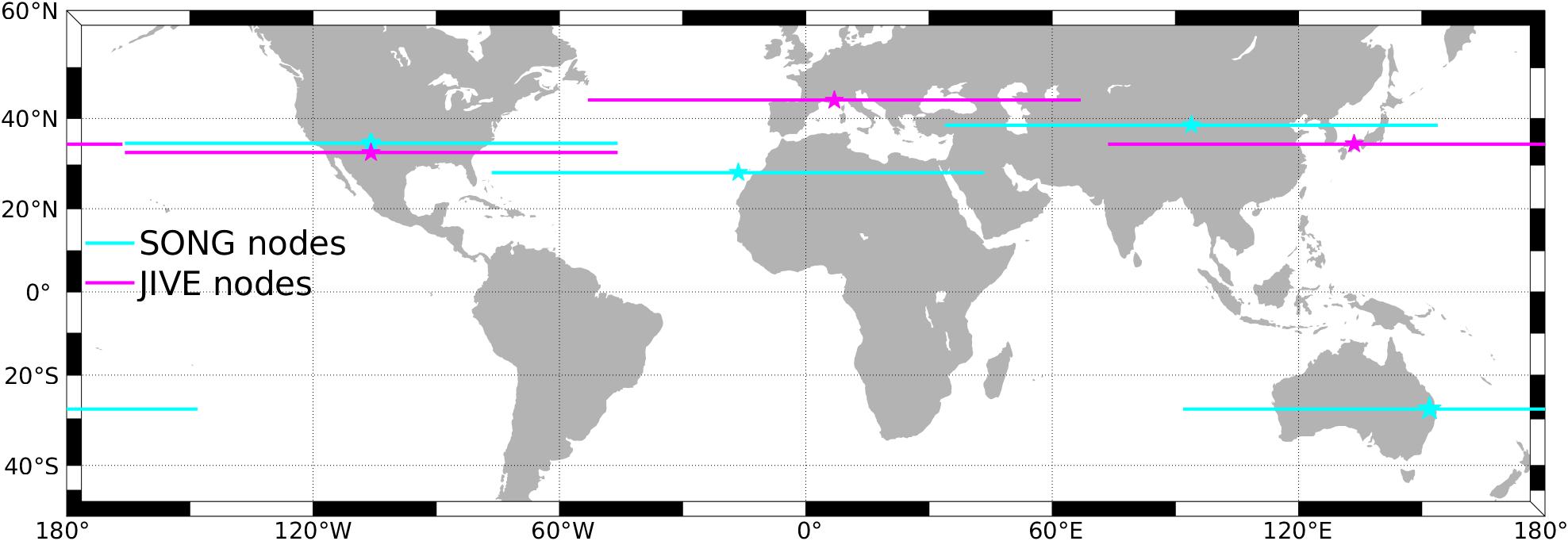
Ground-based observing networks for helioseismology, such as GONG and Bison, have been spectacularly successful. Obtaining nearly-continuous data for other objects than the Sun is also a goal of planetary and stellar seismology. There are at least two current ground-based networks involved in such efforts. One is the Jovian Interiors Velocimetry Experiment, or JIVE, which does Doppler imaging of Jupiter and Saturn to measure global oscillations and atmospheric dynamics. Instruments with this capability have been operating in France, Japan, and Sunspot, New Mexico for a few years now. While planetary seismology is still in its infancy, it holds great promise for uncovering the deep interiors of our giant planets and helping understand solar-system formation. The other project is the Stellar Observations Network Group, or SONG, which involves ultra-precise radial-velocity measurements of bright stars from 1-m class telescopes. SONG has nodes in Tenerife, China, Australia, and one that will become operational in about three years located at Apache Point Observatory in New Mexico. SONG has already produced fantastic science, and we can only expect more as additional nodes in the network come online. SONG also will observe the Sun during the day, providing more important Sun-as-a-star seismic data. Published results from JIVE and SONG can be found here. The two current network configurations are shown in the figure.