Author: Mausumi Dikpati
Oct 31, 2022
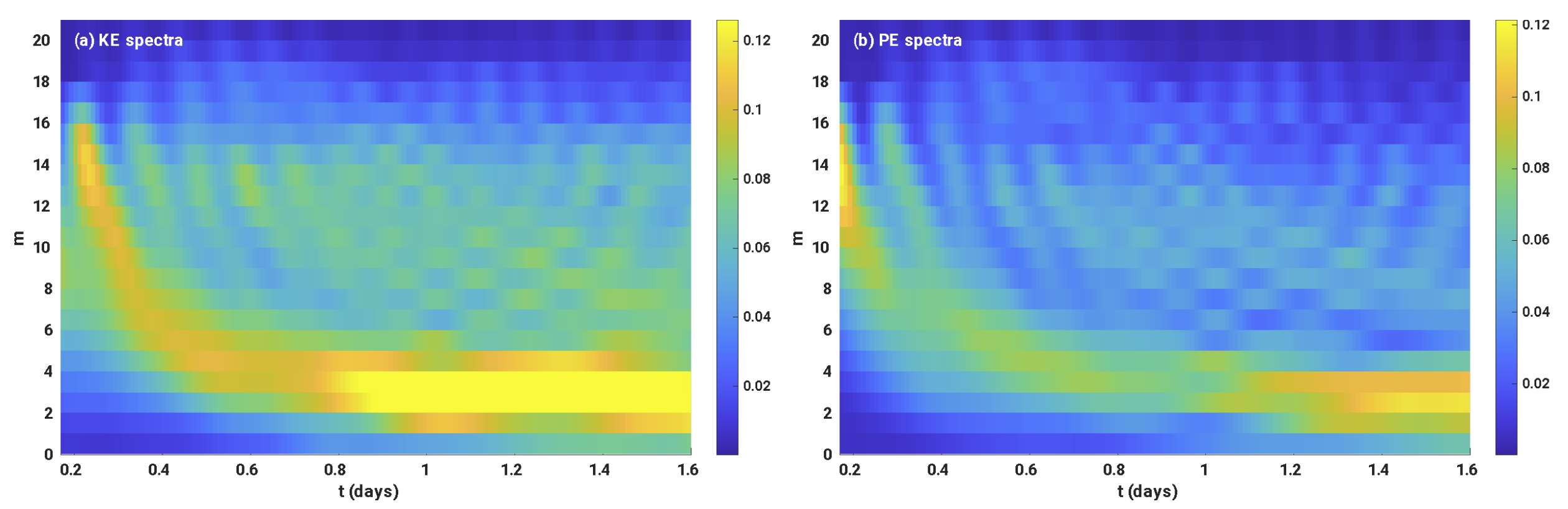
Rossby waves have been found at several levels in the Sun, most recently in its supergranule layer. Working in a big team of COFFIES members (DOI:10.3847/1538-4357/ac674b), we show that Rossby waves in the supergranule layer can be excited by an inverse cascade of kinetic energy from the nearly horizontal motions in supergranules. We illustrate, using a hydrodynamic shallow-water model for a 3D thin rotating spherical shell, how initial kinetic energy at small spatial scales inverse-cascades quickly to global scales, exciting Rossby waves with Rossby-Haurwitz type dispersion relation. Like supergranules, the initial small scale motions in our model contain very little vorticity compared to their horizontal divergence, but the resulting Rossby waves are almost all vortical motions (generation of vortical flows are shown in this animation). The figure shows how kinetic (panel a) and potential (panel b) energies migrate smoothly from wave number m=15 down to a band of energy in wave numbers one to four, with a peak at m=2,3 as a function of time.
Rossby waves are being manifested in the Sun all the way from the solar core to the corona; our team-effort provides a conceptual picture of Rossby waves in the Sun, and how their roles may be different at different radii from the solar core, including destabilizing the latitude gradient of rotation and toroidal fields in the tachocline, leading to surface patterns of magnetic activity, creating a spectrum of Rossby waves in supergranules layer, causing longitudinally propagating coronal structures. Follow-on work is under progress.
Dikpati, M., Gilman, P. A., & Guerrero, G. A.. 'Simulating Solar Near-surface Rossby Waves by Inverse Cascade from Supergranule Energy'. ApJ, 931, 117 (2022). DOI:10.3847/1538-4357/ac674b