Author: Alexander Kosovichev & Valery Pipin
Apr 28, 2023
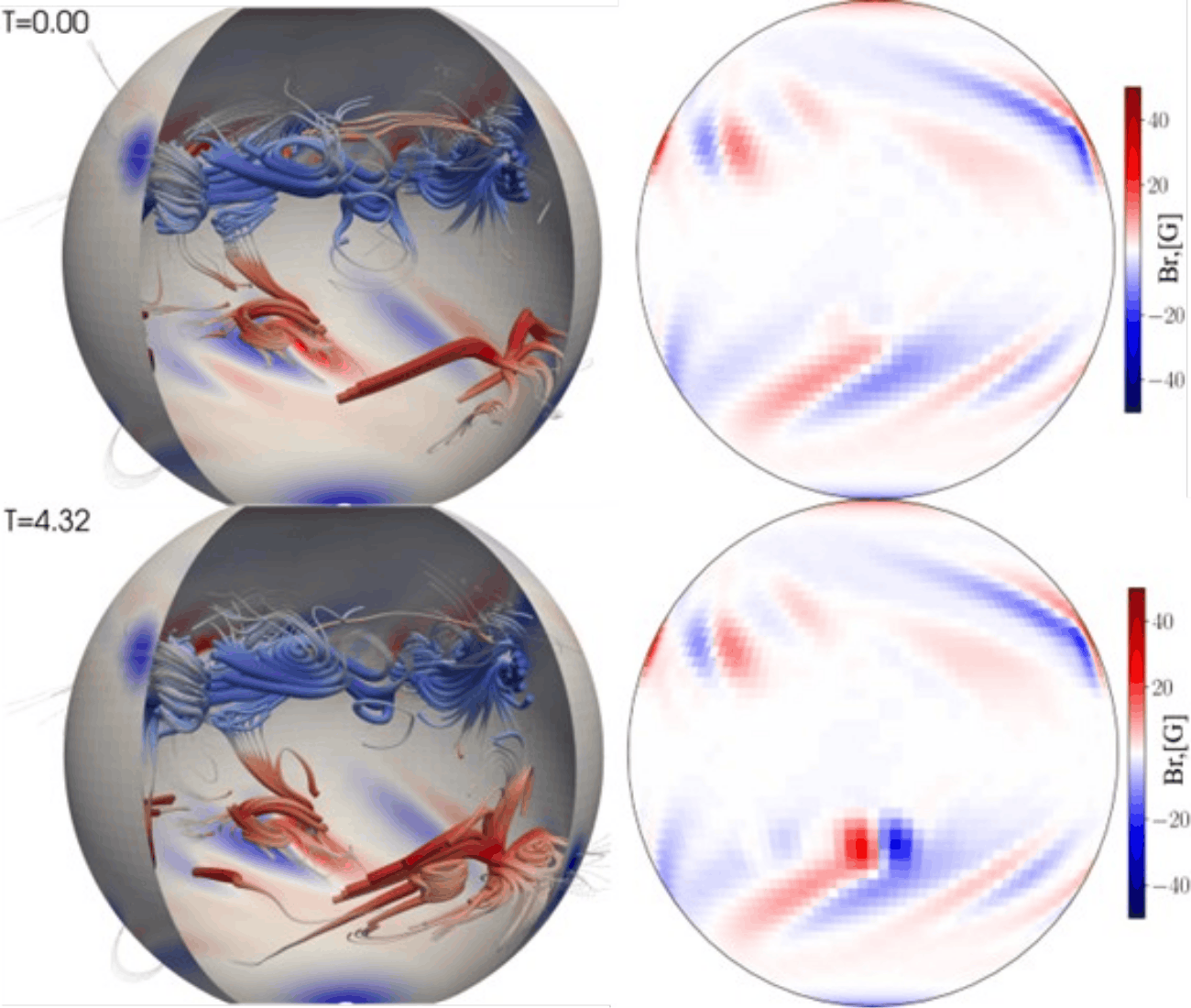
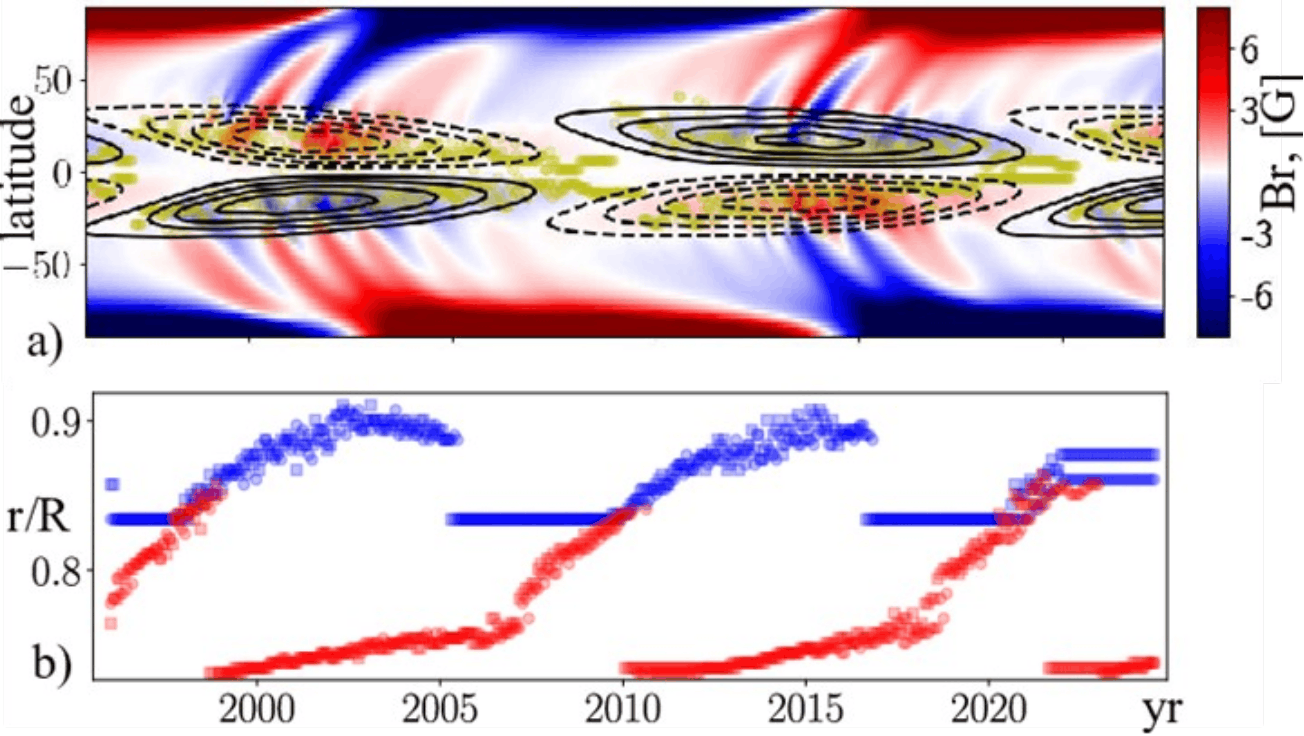
The key idea of the solar dynamo models is that the poloidal magnetic field of the Sun is generated from rising loops of the toroidal magnetic field in the deep convection zone, which are twisted around the radial direction by turbulent cyclonic motions (‘the alpha effect’). The resulting loops of the poloidal field coalesce into a large-scale poloidal magnetic field of a new solar cycle. The subsequent stretching of the poloidal field by the differential rotation produces the toroidal field (‘the Omega effect’). The 22-year cyclic process of the magnetic field generation and transformation represents dynamo waves, forming the magnetic butterfly diagram and reversing the magnetic polarity of the Sun’s global magnetic field. In addition, occasional strands of toroidal flux tubes emerge on the surface due to the magnetic buoyancy instability in the form of east-west oriented Bipolar Magnetic Regions (BMRs). To evaluate the role of BMR in the global models, we develop a 3D mean-field model, which includes the mechanism of the magnetic buoyancy instability resulting in the formation of BMRs in the convection zone and their emergence on the surface (Pipin, 2022; Pipin, Kosovichev & Tomin, 2022). This new type of mean-field dynamo modeling combines Parker’s and Babcock-Leighton’s scenarios of the solar cycles. In this work, we model the physical parameters of Solar Cycles 23 and 24 and the rising phase of Cycle 25 using a nonlinear dynamical mean-field dynamo model that includes the formation and evolution of bipolar magnetic regions. The initialization of BMRs is modeled in the framework of Parker’s magnetic buoyancy instability. It defines the depths of the BMR initialization, typically located at the edge of the global dynamo waves. The distribution of the initial perturbations for the buoyancy instability with longitude, latitude, and size is prescribed according to the distribution of active regions in Solar Cycles 23-25 recorded in the NOAA database. This distribution constitutes the data-driven part of the model.
The modeling results showed that only the initial perturbations located in the upper half of the convection zone lead to magnetic active regions on the solar surface. While the bipolar magnetic regions initialized in the lower part of the convection zone do not emerge on the surface, they still affect the global dynamo process. The model qualitatively reproduces the observed North-South asymmetry of these cycles and the variations of the zonal flows (torsional oscillations) and the meridional circulation, including the extended cycle phenomenon, as well as the enhancement of meridional flows converging towards the emerging BMRs and the cross-equatorial meridional flows during the solar maxima. The variations of the meridional circulation are closely related to the torsional oscillations. These variations show the North-South asymmetry. The model indicates that the BMR’s activity induces additional azimuthal acceleration force. It has the same order of magnitude as the other forcing sources of the torsional oscillations, caused by large-scale dynamo-induced variations of turbulent stresses, inertia forces, and variations of the meridional circulation.
Our results show that the formation and emergence of bipolar magnetic regions (BMR) play a substantial role in the dynamo processes and affect the strength of the solar cycles. However, the data-driven model indicates that the BMR’s effect alone cannot explain the weak Cycle 24. Instead, this weak cycle and the prolonged preceding minimum of magnetic activity were probably caused by a decrease of the turbulent helicity in the deep convection zone during the decaying phase of Cycle 23.
Pipin, V. V., Kosovichev, A. G., & Tomin, V. E. 'Effects of Emerging Bipolar Magnetic Regions in Mean-field Dynamo Model of Solar Cycles 23 and 24'. ApJ, 949, 7 (2023). DOI:10.3847/1538-4357/acaf69